
Blogs

Who Does the Work Nobody Thanks You For

Sara is the first person on her team to notice when the shared drive turns into a mess. She books the room for the quarterly review, sends the agenda the night before, and takes the notes because nobody else opened a document. When someone new joins, Sara walks them to the coffee machine and tells them which manager prefers a call to an email. When there's a birthday, the card that goes round has her handwriting on the envelope.
None of this is in her job description. None of it came up in her appraisal. Her manager called her "a great team player" and moved on to her targets.
She gets home at seven. The milk is nearly finished, and she knows because she checked the fridge that morning. Her son's school trip form is due on Friday. Her partner's mother has a birthday on Sunday and the present still needs posting. Her partner is a decent man. He cooks most weeknights and he'll happily post the parcel. He just won't know the parcel exists until she tells him.
Some evenings Sara sits in the car outside the house for a few extra minutes before going in. She isn't sad, exactly. She's tired in a way sleep doesn't fix. When she tries to explain it later, it comes out as "I do everything round here," and he hears an accusation. He points to the dinner he made. She points to the form. They both go to bed feeling unappreciated.

The work that doesn't show up anywhere
The economists Linda Babcock, Maria Recalde and Lise Vesterlund have spent years studying what they call non-promotable tasks. These are jobs an organization needs done that won't move anyone's career forward: organizing the event, sitting on the committee, taking the minutes, training the intern.
In their experiments, groups had to find one person to take on a task everyone preferred someone else to do. Women volunteered more often. They were also asked more often, by men and by women. When asked, women said yes 76% of the time and men 51%. Then the researchers put people in single-sex groups, and the gap disappeared. The difference came from expectation. Everyone in the room had already learned who was likely to say yes.
The sociologist Allison Daminger found the same shape at home. She interviewed 35 couples and broke household work into its thinking parts: anticipating what's needed, identifying the options, deciding, and monitoring whether it got done. Most couples shared the deciding fairly evenly. The anticipating and the monitoring, the noticing at the start and the checking at the end, fell mostly to one person. That was usually the woman. In her later, larger study, about a fifth of couples had the man carrying more of it, or the two of them splitting it evenly.

That is the work Sara does all day, in both places. Nobody sees it, because when it's done well nothing happens. The meeting runs. The fridge is full. The form is in the school bag.
How a job quietly becomes yours
It usually starts small and reasonable. You notice the mess before anyone else, so you sort it. You're good at it, so you get asked again. A year later it's yours, and nobody can remember deciding that. The communication researchers Jess Alberts and Angela Trethewey describe this as a difference in thresholds. The person who gets uncomfortable first acts first, and the task settles on them.
Babcock has said she did this herself as a manager. When she needed someone for a thankless job, she went to the people she knew would agree. Most managers do. It's the path of least resistance, and it hands the most reliable person on the team more work that won't count.
Then comes the resentment, and it runs both ways. Daminger and colleagues at Harvard Business School interviewed couples repeatedly through the pandemic. Women's resentment grew when they had to keep asking for help. Men's grew when the help they did give went unnoticed, or when they felt marked against expectations nobody had spelled out. That is Sara and her partner at the kitchen table. He's counting meals. She's counting forms. Each of them is right about their own column and can't see the other one.
There's a practical cost as well. Hours spent on non-promotable work are hours taken from the work that gets people promoted, which is one reason Babcock's team links these tasks to slower career progress. At home the cost is a tiredness with no physical cause, and a relationship where both people feel like the one giving more.
What shifts it
Telling people to just say no rarely works on its own. Babcock points out that women who turn these tasks down can face backlash at work, and at home a flat "I'm not doing it any more" tends to become a standoff over the milk. What helps is making the hidden work visible, then handing it over whole.
If you're the one carrying it, start with a list. For one week, write down every task you notice before anyone else does, including the thinking ones: remembering, checking, chasing. It's usually longer than you expect, and it gives the other person something concrete to look at instead of a feeling to argue with.
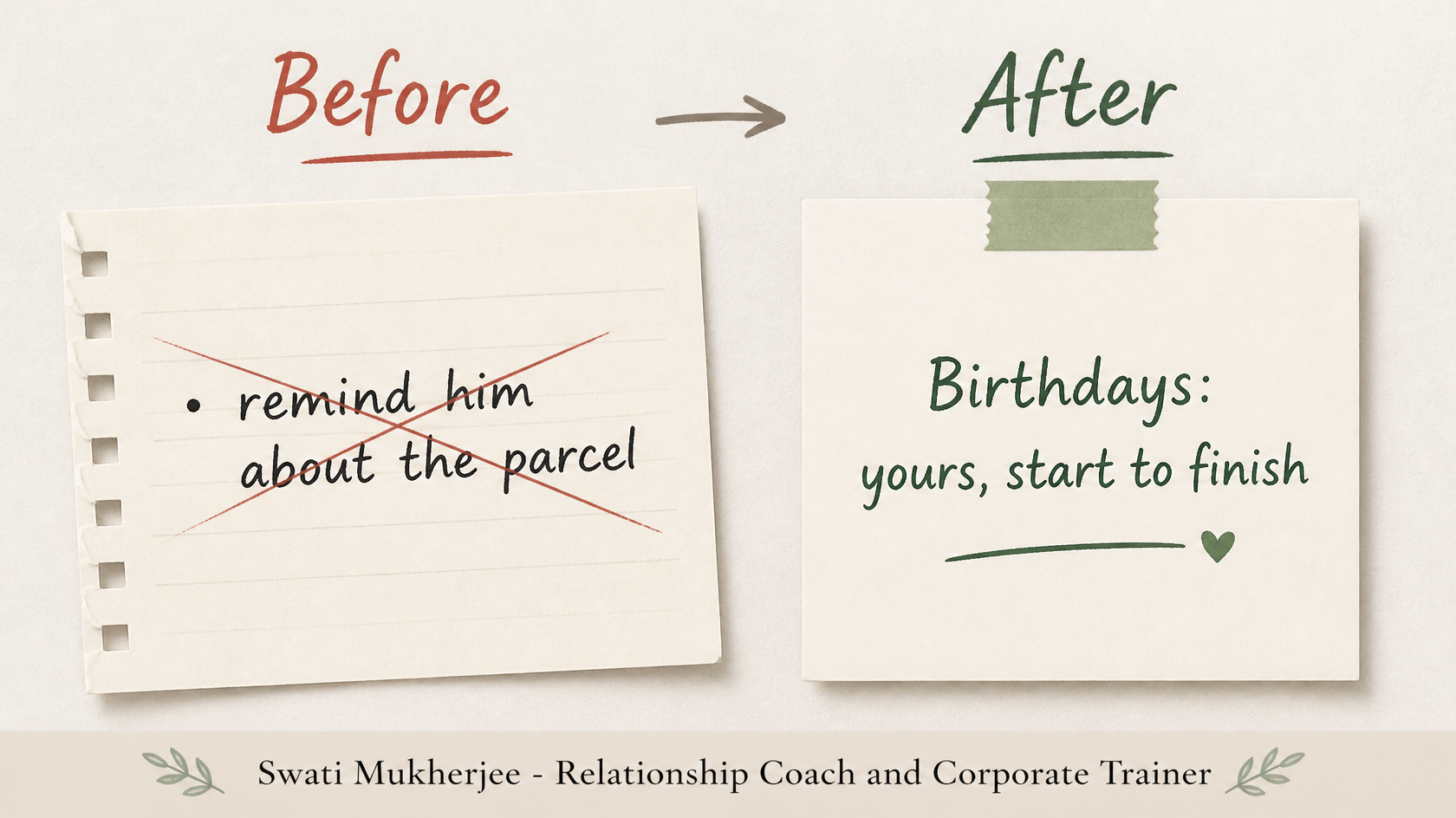
Then hand over whole tasks, from noticing to finished. "Can you post the parcel?" keeps you as the manager. "Birthdays on your side of the family are yours from now on" gives the job away. Leave it with them, even when it gets done later or differently than you'd have done it.
At work, stop filling the first silence. Next time someone asks who'll take the notes, wait. If nobody moves, suggest a rota.
If you're the one benefiting, look for the work before it's pointed out to you. In the pandemic study, resentment eased in couples where the man became more attuned to what the household needed without prompting, and the woman delegated more clearly. Both moves mattered.
And thank people for the specific thing. The psychologist Amie Gordon and her colleagues found that people doing more of the household work were less satisfied with their relationships, and that the effect disappeared when they felt appreciated by their partner. "Thanks for sorting the school trip" lands. "You're amazing" slides off.
If you manage a team, check who took the notes at the last five meetings, who organized the offsite, and who settled in the last three hires. If it's the same name each time, rotate it, and put that work in their review where it can count.
Sara started her list on a Wednesday. By Sunday it covered both sides of a page. Her partner read it standing in the kitchen with his coat still on. He didn't say much that night. A few days later he asked her where the school forms usually came from.
Sources
•Babcock, Recalde, Vesterlund: women and non-promotable tasks (American Economic Association)
•Gender differences in accepting requests for low-promotability tasks (summary)
•Daminger (2019), The Cognitive Dimension of Household Labor
•Daminger (2022), Thinking Gender, doctoral dissertation
•Daminger, McGinn et al., gratitude and resentment within households (HBS Working Knowledge)
•Gordon et al. (2022), Feeling appreciated buffers against unequal division of household labour
•Alberts and Trethewey, Love, Honor, and Thank (Greater Good)

Handcrafted by Coach Foundation | Copyright © 2023 Swati Mukherjee's Coaching. All Rights Reserved.