
Blogs

The Scar You Think Everyone Can See

What Sam heard
Sam's annual review lasted twenty-five minutes. His manager, Daniel, spent most of it on the good things: two clients renewed, a project delivered early, a junior colleague Sam had quietly trained up. Near the end, Daniel said, "Next year I'd like you to take more ownership of the client calls."
Sam doesn't remember much of the first twenty minutes. He remembers that sentence. He replayed it on the train home and again in the shower. More ownership. So he wasn't taking enough. So Daniel had noticed. So everyone had noticed.
When he got home, his partner Sara was cooking. Without turning round, she said, "Did you manage to call the plumber?"
"I've been at work all day," Sam said, louder than he meant to. "I can't do everything."
Sara put the spoon down. She'd asked about a plumber. Somehow, they were now having an argument about whether Sam did enough.
Nobody in Sam's day had criticized him. He had still spent the whole of it feeling criticized, at work and at home, by two people who were both on his side.
The scar that wasn't there
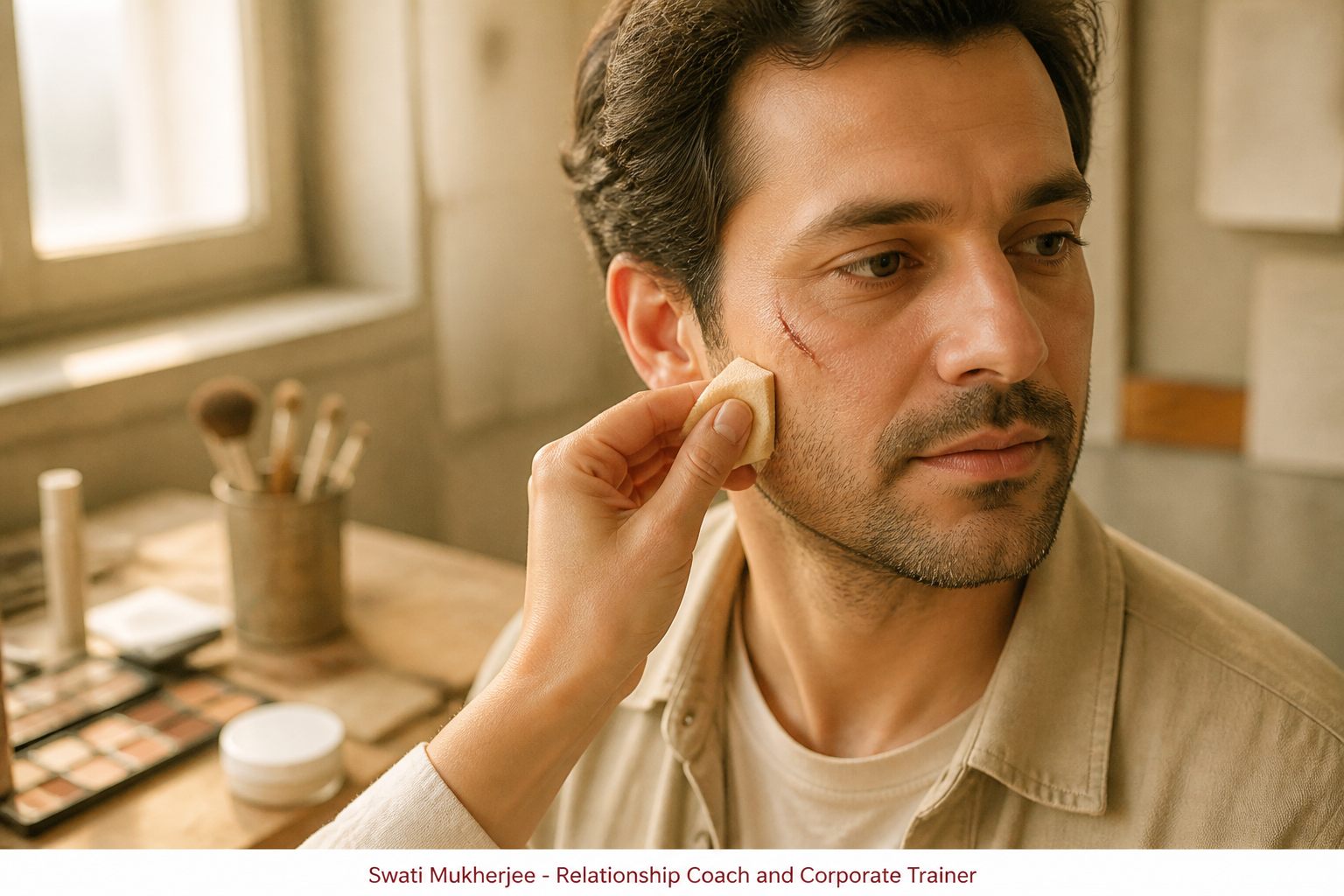
In 1980, two researchers at Dartmouth College, Robert Kleck and Angelo Strenta, ran an experiment I think about almost every week.
They told each volunteer the study was about how people react to someone with a facial disfigurement. A make-up artist painted a realistic scar across the volunteer's cheek, and they were shown it in a mirror so they knew exactly how it looked. Then they were sent off to have a conversation with a stranger and report afterwards on how that person had treated them.
There was one detail the volunteers didn't know. Just before they left the room, the make-up artist said the scar needed a little moisturizer so it wouldn't crack. In fact, they wiped it off. Every volunteer walked into that conversation with a clear, unmarked face.
They came back with detailed reports anyway. The stranger had been tense. They kept glancing at the scar. They'd been a bit patronizing, a bit awkward, keen to finish. The stranger had seen nothing unusual, because there was nothing to see. The volunteers had seen it all.
What changed was what they expected. Once they believed something about themselves was visible and unwelcome, ordinary glances and pauses started to look like proof.
Where the scar comes from

Most of us are walking around with a scar like that. It's an old belief about what's wrong with us, and we're quietly sure other people can see it.
Sam's started with a red pen. His father checked his homework every evening, and he was a careful, clever man who believed that pointing out mistakes was how you showed you cared. Sam doesn't remember the praise, though there must have been some. He remembers the red pen, and the feeling of waiting for it. By the time he was ten, he'd learned to look for the mistake before anyone else could find it.
Other people's scars are different. You're too much. You're not quite clever enough. You're lazy. You're difficult to love. Usually someone said it once or twice, or showed it without saying it, at an age when we couldn't argue back. We forget the moment, but we keep the belief.
The brain is built to save effort. When a situation is unclear, it fills the gaps with what it already expects. A short email, a pause in a meeting, a question asked without looking up from the cooker: none of these comes with an explanation, so the brain supplies one. If you carry a scar, the explanation is nearly always the scar.
Same scar, two rooms

The scar doesn't stay in one part of your life. Sam carries the same face into the office and into the kitchen, so the same misreadings happen in both.
At work, it looks like this. Sam prepares for every meeting as if he's about to be cross-examined. He rarely asks for help, because asking would show the gap he's sure is already visible. When Daniel replies to an email with one line, Sam reads it as irritation. When a colleague is copied in on something, he wonders what they've been told about him. In feedback conversations he starts explaining before the other person has finished, because he heard the criticism coming three sentences ago.
At home, it looks like this. Sara asks a question, and Sam hears a complaint. She mentions the bins, and he hears "you never do anything." He either apologizes too much or snaps, and sometimes he does both in the same evening. When she's quiet after a long day, he assumes he's done something wrong and spends the night trying to work out what.
In my HR years I sat in a lot of feedback conversations that went wrong this way. A manager would say something fairly mild, and the employee would leave the room having heard something much harsher. When I later started working with couples, I heard the same thing from partners. "I only asked if he'd called the plumber." The words were small. What landed was the old scar.
How the scar makes itself come true
The painful part is what happens next. If you treat people as though they're judging you for long enough, they start to behave in ways that look a lot like judgement.
Psychologist Geraldine Downey at Columbia University has spent years studying people she calls rejection sensitive: people who anxiously expect to be rejected and read it into situations that don't contain it. In one of her studies with couples, the partners of rejection-sensitive people became noticeably angrier after a disagreement. They hadn't started out unkind. The defensiveness and coldness they'd been met with during the argument had pushed them there.
That is what began to happen around Sam. Daniel noticed that every piece of feedback turned into a long, tense conversation, so he started giving less of it. Sam read the silence as disapproval. Sara stopped asking him to do things, because every request turned into a fight. Sam noticed she'd stopped asking and decided she'd given up on him.
Nobody in either room had wanted to criticize Sam. By reacting to a scar that wasn't visible, he slowly taught both of them to tread carefully around him. Then he took their carefulness as proof that the scar was there all along.
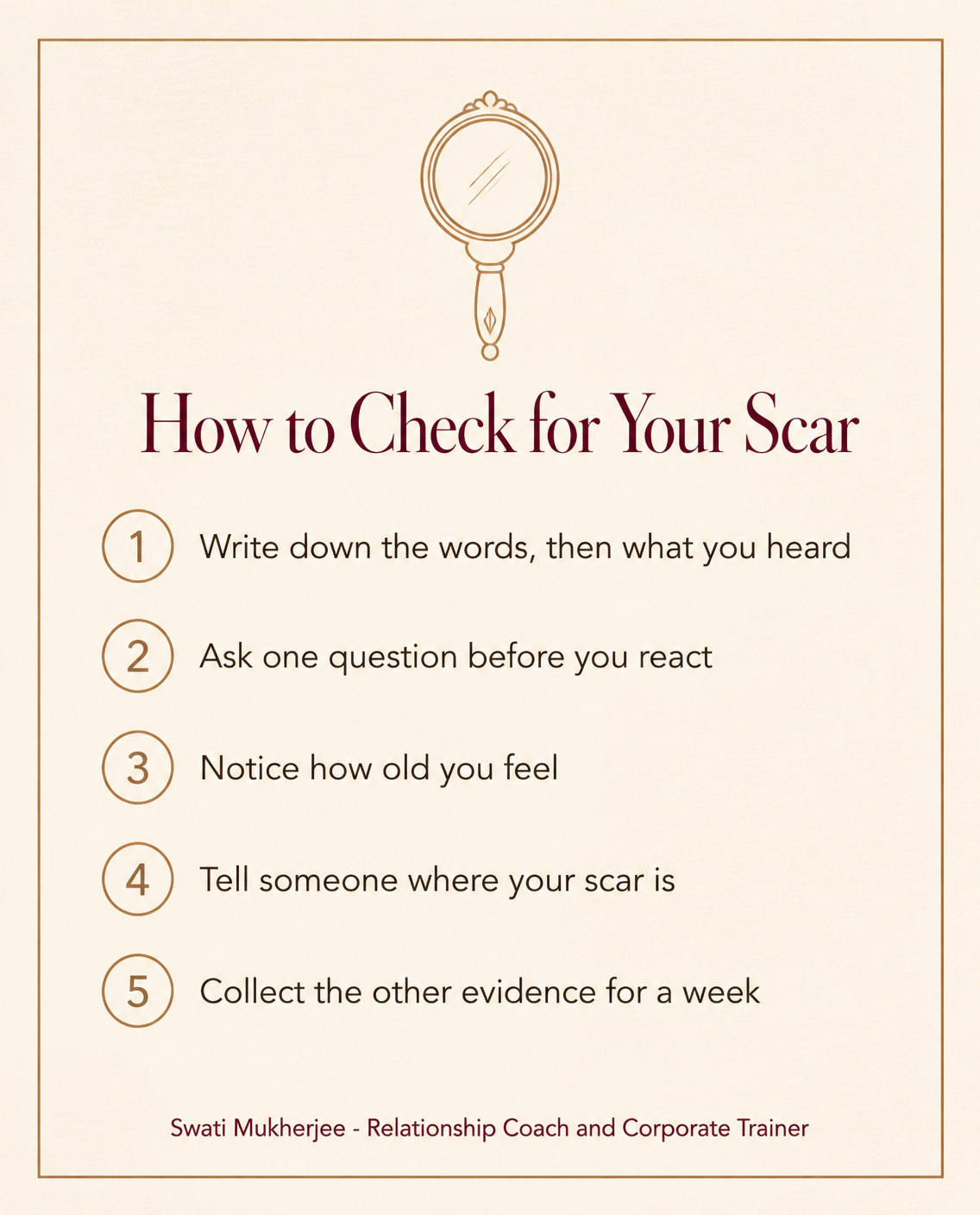
How to check for your scar
You can't wipe an old belief off in one go the way the make-up artist wiped off the paint. What you can do is learn to notice when it's doing the hearing for you. These five steps work at work and at home.
1. Write down the words, then what you heard
The next time a comment stings, write two lines. First, the exact words the other person said. Second, what you heard. Sam's would read: "Take more ownership of the client calls." Then: "You're not good enough." The gap between those two lines is where your scar lives.
2. Ask one question before you react
"When you said that, what did you mean?" It sounds simple, and it feels risky, because you're bracing for the worst answer. Most of the time, the answer is far smaller than the one you'd already decided on.
3. Notice how old you feel
Scar reactions come with a familiar age. If a comment from your manager makes you feel ten years old and waiting for the red pen, that's a clue. The feeling belongs to then. The situation is happening now.
4. Tell someone where your scar is
Pick one person at home and, if you can, one at work, and tell them plainly. "I'm quick to hear criticism. If I react badly to something small, it's probably that." Once they know, they can help you check. They also stop taking your reactions personally.
5. Collect the other evidence for a week
For seven days, write down every time someone thanks you, asks your opinion or relies on you. People with a scar are excellent at collecting proof that it's there and poor at noticing the evidence that it isn't. This evens the record up.
If you're on the other side
Perhaps you recognize Daniel or Sara more than Sam. You manage someone who hears every comment as an attack, or you live with someone who does. It's exhausting, and it's tempting to do what they both did: say less, tiptoe more, and let the silence grow.
A better move is to say out loud the thing you aren't saying. Before feedback, Daniel could have said, "This isn't a warning. You've had a strong year, and I want to give you more." Sara could have said, "I'm only asking about the plumber. I'm not keeping score." It can feel unnecessary to spell out something so obvious. For a person with a scar, it isn't obvious at all, and one sentence can stop them filling the gap with the worst reading.
The second move is to keep going. Don't stop giving feedback or making requests because they're hard to receive. Pulling back confirms the scar. Steady, ordinary honesty, delivered kindly and often, slowly proves it wrong.
What Sam found out

It took Sam two weeks to ask Daniel what he'd meant. He rehearsed the question so many times that it came out almost as a joke. "When you said more ownership of the client calls, should I have been worried?"
Daniel looked confused. Then he laughed. "No. I want to put you forward to lead the new account in spring. I was trying to give you a heads-up."
Sam had carried a warning around for two weeks. Daniel had been offering him a promotion.
That night he told Sara about the red pen. He'd never told her before. She was quiet for a moment, and then said, "So when I ask about the plumber, what do you hear?" He told her. She said, "I'm only ever asking about the plumber."
The scar didn't vanish. Sam still feels it when an email is short or a meeting goes quiet. The difference is that he now knows where it is, and so do the two people closest to him. They can help him check before it does the talking.
If this sounds like you, at work, at home or in both places, you don't have to untangle it alone. In my coaching, we find the old belief underneath the reactions and change how you hear the people around you. Book a private consultation and we'll start with the sentence that stung most recently.
If you lead a team and recognize Daniel's side of this story, my free Professional Proximity Blueprint has practical ways to make feedback land the way you meant it. It's there if it's useful to you.

Handcrafted by Coach Foundation | Copyright © 2023 Swati Mukherjee's Coaching. All Rights Reserved.