
Blogs

Micromanaging at Work, Controlling at Home

Two small fixes before lunch
Sam runs a small team at a logistics company. On a Tuesday morning, he opens an email his newest team member has drafted for a client. It's fine. He changes "Hi" to "Hello", moves the second paragraph to the top, adds a line about the delivery window and sends it back with a note: "Small tweaks, just so it lands right." It takes him longer than writing it himself would have.
That evening his partner loads the dishwasher. Sam waits until she's left the kitchen, then opens it and moves the bowls to the top rack and the glasses to the left, where they fit better. Later he asks whether she locked the car. She did. He checks anyway.
Sam would call himself careful. His team would probably say thorough. Nobody says the other word out loud. But his team has started sending him drafts at the last possible minute, and his partner no longer offers to cook when his parents come over.
Why checking feels like being responsible
From where Sam sits, each of these moments is about responsibility. If the email goes out wrong, it's his name on the account. If the car gets broken into, he's the one who should have checked.
Psychologists have a name for what he's managing: intolerance of uncertainty. It describes how hard a person finds it to sit with not knowing how something will turn out. It was first studied in people who worry chronically, and a strong need for control is one of its most common features.
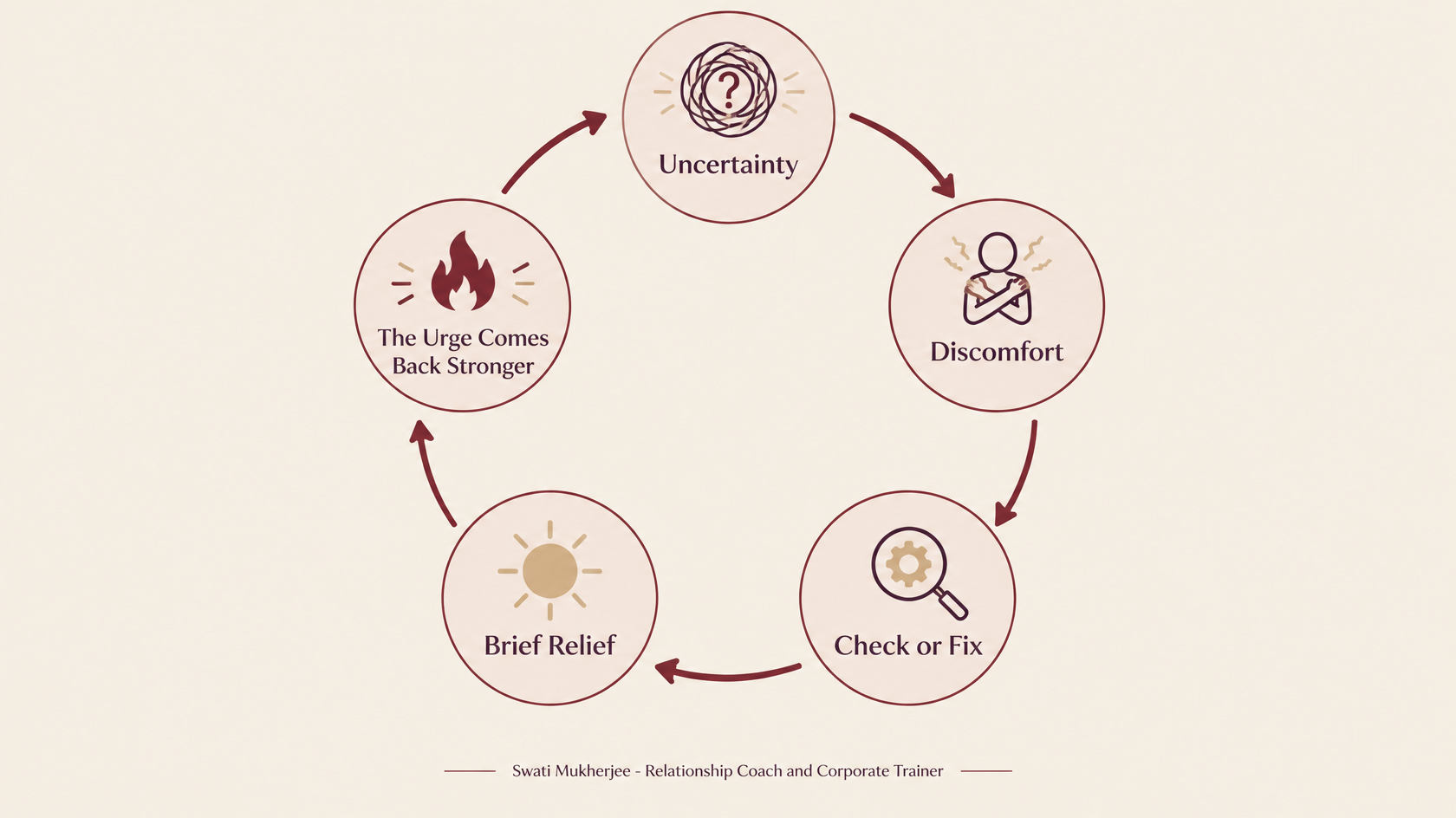
The part that keeps it going is simple. Checking, fixing and asking for reassurance bring the anxiety down for a moment. That relief teaches the brain that the uncertainty really was dangerous, so the urge to check comes back stronger next time. Every edit Sam makes buys him a few minutes of calm, and makes the next edit feel more necessary.
This is why "just trust your team" or "just let it go" rarely lands with someone like Sam. Trust is exactly the thing he can't reach yet. What he can reach is the moment the discomfort shows up, before his hand goes to the keyboard or the dishwasher door.
What it teaches the people around him
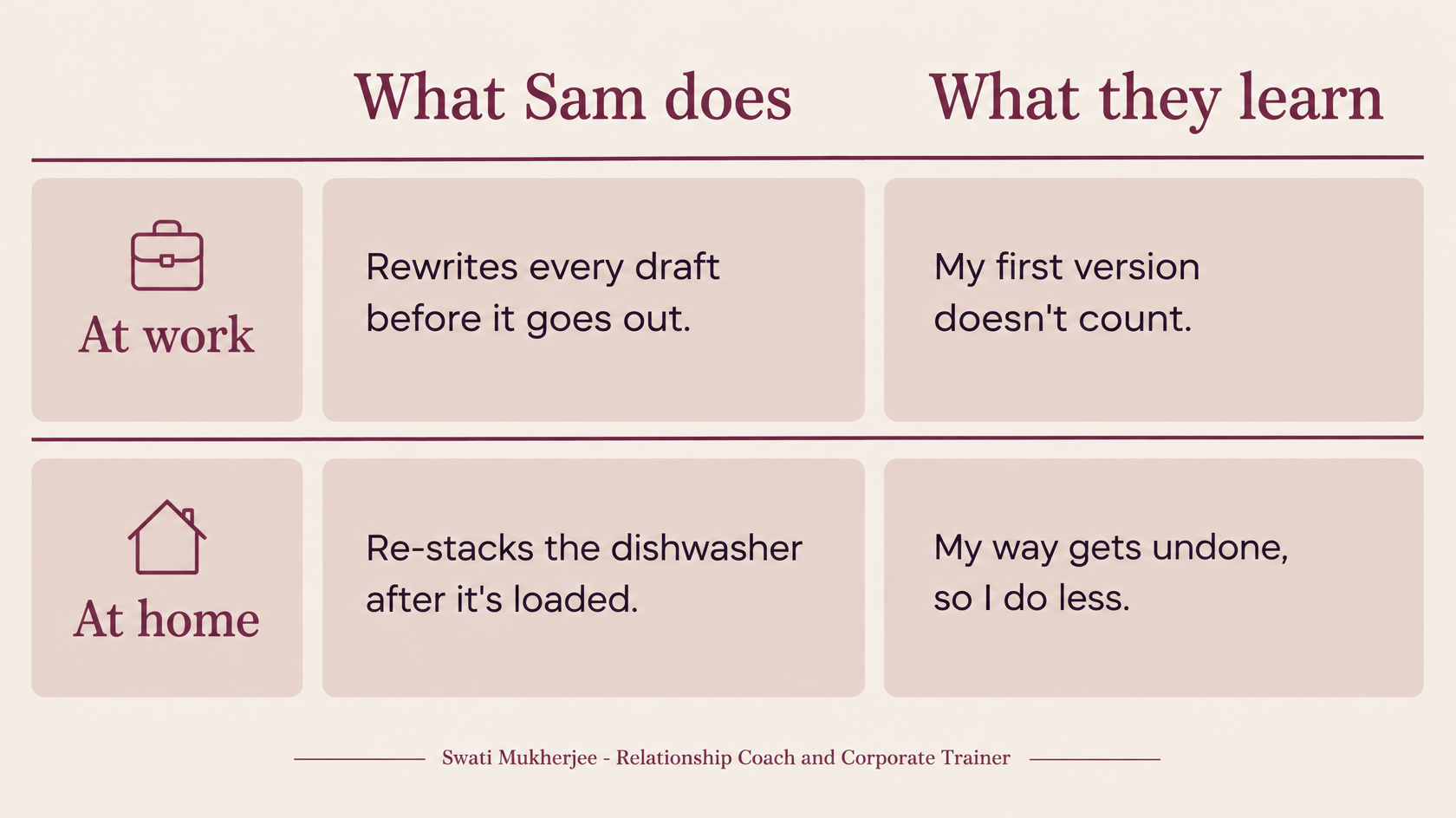
When every draft comes back changed, people learn that their first version doesn't count. They stop thinking about the client and start guessing what Sam will want. Decisions slow down because they all route through him. Then he looks at a team that waits to be told and concludes they need closer supervision.
Home runs the same loop. His partner learns that her way of doing things gets undone, so she does fewer things. Sam picks up the slack, feels tired and alone with it, and reads her stepping back as proof he can't rely on her. Each side's behavior confirms the other side's story.
The relationship research has a name for what Sam keeps refusing: influence. In a study that followed 130 newlywed couples for six years, John Gottman and his colleagues at the University of Washington found that the husbands who accepted influence from their wives were the ones in happy, stable marriages. The study looked at husbands, but the Gottman Institute is clear that it applies both ways. Accepting influence means letting your partner's view actually change what you do. Re-stacking the dishwasher is a small refusal, repeated daily.
There's a second finding Sam would find harder to argue with, because it's about him. In two studies of close friendships, researchers in self-determination theory looked at autonomy support: letting the other person make their own choices and backing them while they do. Receiving it predicted better relationship quality, which you'd expect. Giving it predicted the giver's own relationship quality too. When the two were compared, giving autonomy support was the stronger predictor of the giver's wellbeing. So the person who loosens their grip gets something back, and it's more than a calmer team.
What changes it
If you recognize yourself in Sam, start with the moment before you step in. Ask yourself one question: what am I afraid will happen if I leave this alone? Sam's honest answer about the email was that the client might think the team was sloppy. His honest answer about the dishwasher was nothing much. A bowl might come out with a mark on it. Saying the fear out loud, even just to yourself, separates the real risks from the habits.
Then sort standards from preferences. Some things genuinely need to be done a certain way: the wording of a contract, the front door locked at night. Agree those together, clearly, once. Everything else is preference, and preference belongs to whoever is doing the job.
At work, hand over the outcome and keep out of the method. Say what done looks like, when it's due and when you'll look at it, then stay out until that point. "Send it to the client by Thursday and flag me if the dates move" hands the job over. "Send it to me first" keeps it yours.
Let one imperfect version stand and watch what actually happens. You'll feel the pull to fix it. Notice it and leave it. Each time nothing goes wrong, the case for checking gets a little weaker, and that is how the tolerance for not knowing grows. Nobody gets there by deciding to.
And before you correct something, ask: "Do you want my input, or are you happy with it?" Then go with the answer, including when it's "I'm happy with it."
If you live or work with someone like Sam, describe the specific moment and what it does to you. "When you redo the dishwasher after I've loaded it, I stop wanting to help" gives him something he can look at. "You're so controlling" gives him something to defend against. You can also ask him what result he actually needs and offer to own that result your way.
The first week Sam tried this, he left one email alone. He read it twice, closed the tab and opened it again an hour later to see whether the client had replied. They had. They had a question about the delivery window. He started typing a suggestion to his colleague, deleted it, and waited to see how she'd answer.
Sources
•Gottman, J. M., Coan, J., Carrere, S. & Swanson, C. (1998). Predicting marital happiness and stability from newlywed interactions. Journal of Marriage and the Family. University of Washington news release
•The Gottman Institute. Emotionally intelligent husbands are key to a lasting marriage
•Deci, E. L., La Guardia, J. G., Moller, A. C., Scheiner, M. J. & Ryan, R. M. (2006). On the benefits of giving as well as receiving autonomy support: Mutuality in close friendships. Personality and Social Psychology Bulletin, 32(3), 313–327. PubMed
•Simply Psychology. Intolerance of uncertainty

Handcrafted by Coach Foundation | Copyright © 2023 Swati Mukherjee's Coaching. All Rights Reserved.