
Blogs

You Keep Score at Home. Your Team Does Too.
The car service
Sara asked Daniel one Sunday evening whether he had booked the car in for its service. He hadn't. He said he'd do it in the morning.
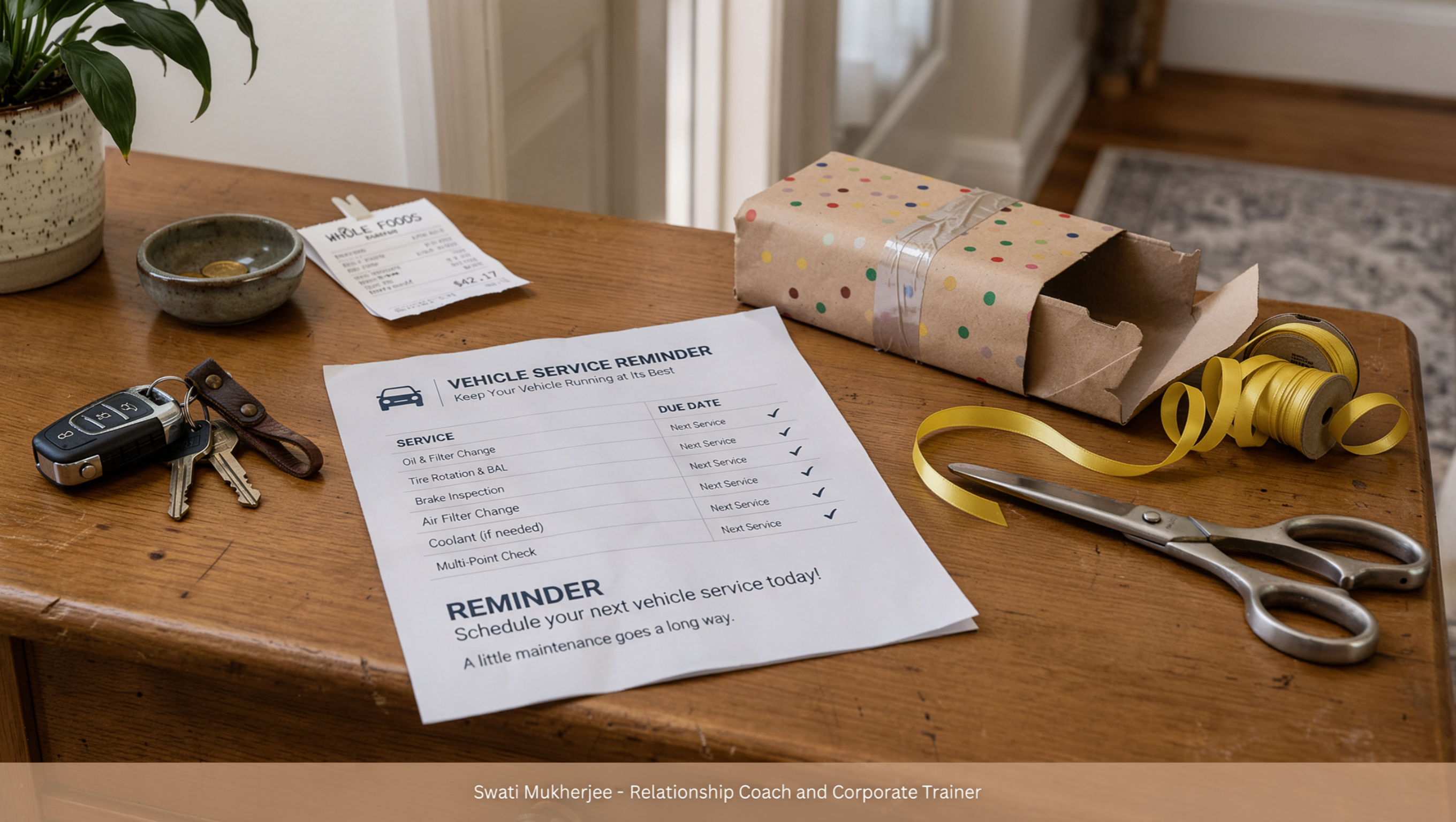
It was a small thing, and Sara knew it was small. But in her head a list opened up. She had planned their last holiday, flights, hotel and the transfer from the airport. She had bought his mother's birthday present and wrapped it. She had waited in for the boiler engineer twice. So when she said "Fine, I'll do it," her voice carried all of that.
Daniel heard the tone and got defensive. "Why are you keeping score?"
She was. So was he. Daniel had his own list, and Sara had never seen it. He had done the 4am airport run for that same holiday. He had spent two weekends on the phone sorting their mortgage renewal. He was the one who noticed when the smoke alarm needed a battery.
Two people in one house, each carrying a private ledger, and each sure theirs was the heavier one. Neither had said a word about it until a car service brought it out.
The same ledger, Monday morning
On Monday morning, in an office across town, a different person is keeping the same kind of list.
Leo has stayed late three times this month to cover a client deadline. Nobody asked him to log it, so nobody knows. In the quarterly review, a process change he suggested in a team meeting gets presented by someone else. His manager, Nina, thanks the room for "great collaboration".
Leo says nothing. He doesn't complain or raise it in his one-to-one. He just stops staying late. He stops offering ideas in meetings. Three months later Nina writes in her notes that Leo seems "less engaged" and wonders what changed.
Nothing changed overnight. Leo had been keeping a count, the way Sara was at home. Each unthanked entry made the total heavier, and at some point he quietly balanced the books himself by giving less.

What the research says
In 1963 a psychologist at General Electric, J. Stacy Adams, put a name to what Sara and Leo were doing. He called it equity theory. People track what they put into a relationship (time, effort, care, ideas) and what they get back (pay, credit, thanks, help). Then they compare their ratio with the other person's.
The key word is perceived. Adams was clear that the inputs only count if the person notices them and thinks they matter. That explains why Sara and Daniel can both feel short-changed at the same time. Each one sees their own list in full and the other person's list only in pieces.
Household research shows how this plays out at home. A US study of dual-earner marriages by Michelle Frisco and Kristi Williams found that when either spouse felt the housework split was unfair, both husbands and wives reported lower marital happiness. For wives, that feeling was also linked to higher odds of divorce. Other studies have found that many couples with an uneven split still rate it as fair. The hours on their own don't settle it. How each partner reads the split does.
At work, one of the clearest studies comes from Jerald Greenberg. In 1990 he studied manufacturing plants that cut pay by 15% for a period. Employee theft rose in the plants where pay was cut. In the plant where managers explained the cut carefully and respectfully, people felt less unfairly treated, and theft was lower. The pay cut was the same. What changed was whether anyone said it out loud.
Why the silent count goes sour
Adams also described what people do once they decide the balance is off. They put in less. They change how they see things, deciding the job or the relationship was never worth much. Or they pull away altogether. None of these needs a conversation, which is why they are so easy to slide into.
Leo cut his input. He stopped staying late and stopped sharing ideas, and he never told Nina why. Sara does something similar at home. She still books the car in and buys the presents, but she does it with a sigh and a short reply, and Daniel picks up on the tone without knowing the reason. He gets defensive and offers less, which gives Sara one more entry for her list.
A ledger kept in private never gets checked. Nobody can point out the entries you missed, so you keep only your version, and it grows in your favour. Daniel's 4am airport run isn't on Sara's list. Sara's two mornings waiting for the boiler engineer aren't on his. Each of them is working from half the numbers and feels certain of the total.
That is how a small, fixable imbalance turns into resentment: months of entries the other person never got the chance to see, explain or share.
Say the count out loud
The fix is the same in a kitchen and in a meeting room. Bring the ledger into the open while the entries are still small, and say them as information. An accusation will only start a new list.
This puts some responsibility on the person keeping score. If you are the one counting, you are also the one who knows the numbers. Waiting for the other person to guess them rarely works.
At home
1.Swap lists. Sara and Daniel each write down what they handled over the past month, then read both lists together. Most couples find entries they had never seen. The point is to see the whole picture, so nobody needs to win.
2.Name the entry when it happens. "I've booked the car in. That's the third admin job I've done this week. Can you take the next one?" One sentence on the day lands better than a list three months later.
3.Thank the specific thing. "Thank you for sorting the mortgage. I know that took two weekends." Naming the effort tells your partner their entry made it onto your list too.

At work
1.Credit by name, in the room. If Nina had said "Leo suggested this change in our team meeting" at the review, it would have cost her nothing and kept him contributing.
2.Ask what you might have missed. A question in a one-to-one, such as "What have you done this month that I might not have seen?", brings the hidden entries to the surface before they turn into a grievance.
3.Explain what you can't make fair. Sometimes the load can't be balanced, whether it is a deadline, a pay freeze or a busy quarter. Greenberg's study suggests a clear, honest explanation reduces the sense of unfairness, even when the outcome stays the same.
None of this needs the scores to come out level. People cope with a lot of imbalances at home and at work. What they struggle with is imbalance that nobody else seems to see.
Back to the car service
When Sara and Daniel finally swapped lists, the car service was still on hers. But so was the airport run, now with a tick next to it. Daniel added the boiler engineer to his list of things Sara does that he never sees. They didn't come out even, and they didn't need to.
If you're keeping a list right now, at home or at work, ask yourself who else has seen it.
Sources
•Adams, J. S. (1963). Toward an understanding of inequity. Journal of Abnormal and Social Psychology, 67(5), 422–436.
•Frisco, M. L., & Williams, K. (2003). Perceived housework equity, marital happiness, and divorce in dual-earner households. Journal of Family Issues, 24(1), 51–73.
•Greenberg, J. (1990). Employee theft as a reaction to underpayment inequity: The hidden cost of pay cuts. Journal of Applied Psychology, 75, 561–568.
•Mikula, G., Riederer, B., & Bodi, O. (2011). Perceived justice in the division of domestic labor: Actor and partner effects. Personal Relationships.

Handcrafted by Coach Foundation | Copyright © 2023 Swati Mukherjee's Coaching. All Rights Reserved.