
Blogs
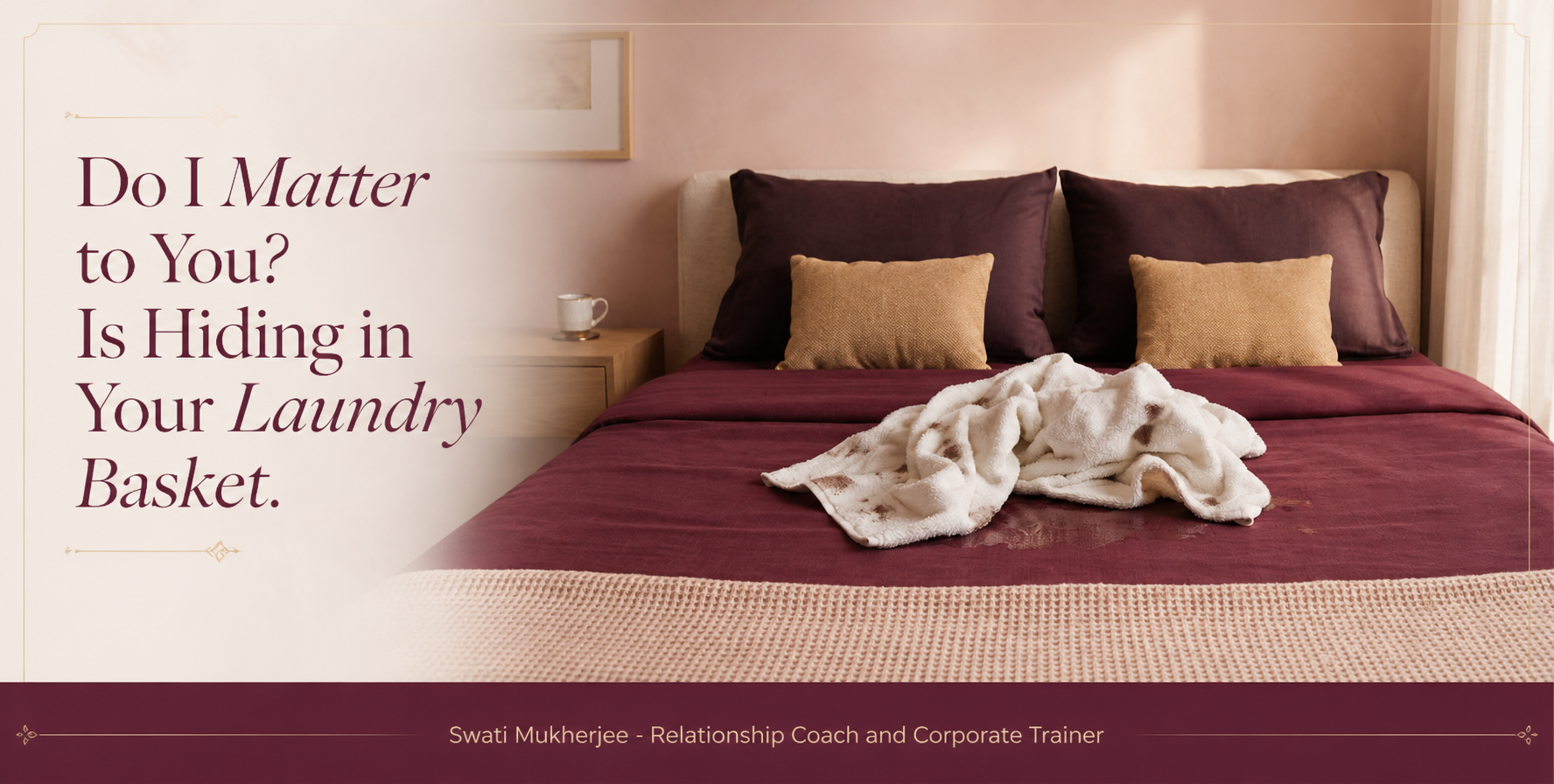
"Do I Matter to You?" Is Hiding in Your Laundry Basket
Maya found Theo's gym clothes on the bedroom floor again on a Thursday night. His socks were balled up next to the basket. Next to it, not in it.
She picked them up, dropped them in and said nothing. By Sunday there was a wet towel on the bed, and this time she said something.
"I'm not your mother, Theo."
He looked up from his phone. "It's a towel. I'll move it."
"You always say that."
"And I always do move it. Eventually."
That last word did it. Ten minutes later they were arguing about who booked the last holiday, whose family they saw more of at Christmas, and the evening he forgot to call when his train was cancelled. Theo went to the kitchen. Maya stayed in the bedroom and folded the towel very neatly, which both of them understood was a message.
Ask either of them what the fight was about and they'd have said laundry. Somewhere, they both knew that wasn't true. Nobody gets that angry about a towel.
The question underneath the towel
When a small argument keeps coming back, it's usually carrying a bigger question that feels too exposed to say out loud.
For Maya, the socks beside the basket said: I've told you this bothers me, and you still don't do it. So does what I ask for count with you? Do I count?
For Theo, the question ran the other way. Every reminder sounded like a verdict on him. Am I ever going to be enough for you, or will there always be one more thing I've got wrong?
Neither of them said those sentences. They said "you always" and "it's just a towel". So the argument went nowhere, because neither of them had named what they were actually asking.
Sue Johnson, the psychologist who developed Emotionally Focused Therapy, built her work around this. She saw most couple conflict as attachment distress. Underneath whatever the topic is, partners are asking some version of "Are you there for me? Do I matter to you?" When the answer feels like no, people protest.
She called the most common version of this the Protest Polka. One partner pushes harder for a response. The other pulls back to get away from the pushing. Each move makes the other person's move worse. The more Maya raised it, the more Theo defended himself, and the more he defended himself, the louder she got.

Why the small stuff hurts so much
John Gottman's team at the University of Washington followed newlywed couples for six years. They watched how partners responded to small bids for attention: a comment about something outside the window, a sigh, a request for help with something. The couples still married at the six-year mark had turned toward those bids 86% of the time. The couples who divorced had done it 33% of the time.
A household request works like a bid. "Can you put your clothes in the basket?" is partly about clothes. It's also a quiet check on whether what she asks for registers with him. Each time it doesn't, she files away a small piece of evidence. By the time the towel lands on the bed, she's reacting to the whole file.

Gottman's research also found that about 69% of couple conflicts are perpetual. They come from lasting differences in personality and habit, and they never fully go away. Theo may never be a naturally tidy person. That's workable. What wears a couple down is having the same fight again and again at the surface, where nobody can win it.
How to find the real question
Notice the size mismatch. A towel on the bed is worth about thirty seconds of irritation. If you're still angry an hour later, your anger belongs to something bigger than the towel. Treat that gap as information.
Finish the sentence. Say the complaint, then add "and what that means to me is..." and keep going. "You left your clothes on the floor, and what that means to me is that when I ask for something, it disappears." Keep going until you reach a sentence that feels uncomfortable to say. That one is usually the real question.
Listen for "always" and "never". These words tell you you're arguing about the whole file, not one evening. Theo's "eventually" landed so hard because it confirmed what Maya already had on file.
Ask what the fight means to your partner. Theo could ask, "When I leave stuff lying around, what does it feel like it says about me and you?" Then he listens without correcting her facts. Gottman's advice for perpetual problems is to hold off on persuading until each person can explain the other's position.
Answer the real question directly. If the question is "Do I matter to you?", a tidier floor is part of the answer, but only part. Maya needs to hear Theo say it out loud. Theo needs to hear that she's asking for him, and that she isn't keeping score on whether he's a perfect housemate.
Then fix the surface problem. Once the real question has had some air, the practical part gets easy. Move the basket to the bathroom where he actually gets changed. Pick a laundry night. These fixes are small because the problem is finally small again.
What changed for Maya and Theo
The turn came on a quieter evening, a week later. Maya said, "I think I'm scared I'm the only one in this house who notices things." Theo didn't have a defense ready for that. He said he'd been feeling like a failed inspection most evenings, and that he'd started tuning her out to get through it.

It was the first honest conversation either of them had about the laundry in months, and it barely mentioned laundry.
They still had the towel conversation a few more times after that. It was shorter, and nobody ended up in the kitchen.
If you and your partner keep having the same argument and can't find what's sitting underneath it, that's the work I do with couples. You're welcome to get in touch.
Sources
Johnson, S. (2008). Hold Me Tight: Seven Conversations for a Lifetime of Love. Little, Brown.
Johnson, S. (2006). "Are You There for Me? Understanding the Foundations of Couples Conflict." Psychotherapy Networker.
The Gottman Institute. "Turn Towards Instead of Away." gottman.com
The Gottman Institute. "An Introduction to Emotional Bids and Trust." gottman.com
Gottman, J. M. & Silver, N. (1999). The Seven Principles for Making Marriage Work. Three Rivers Press.

Handcrafted by Coach Foundation | Copyright © 2023 Swati Mukherjee's Coaching. All Rights Reserved.