
Blogs
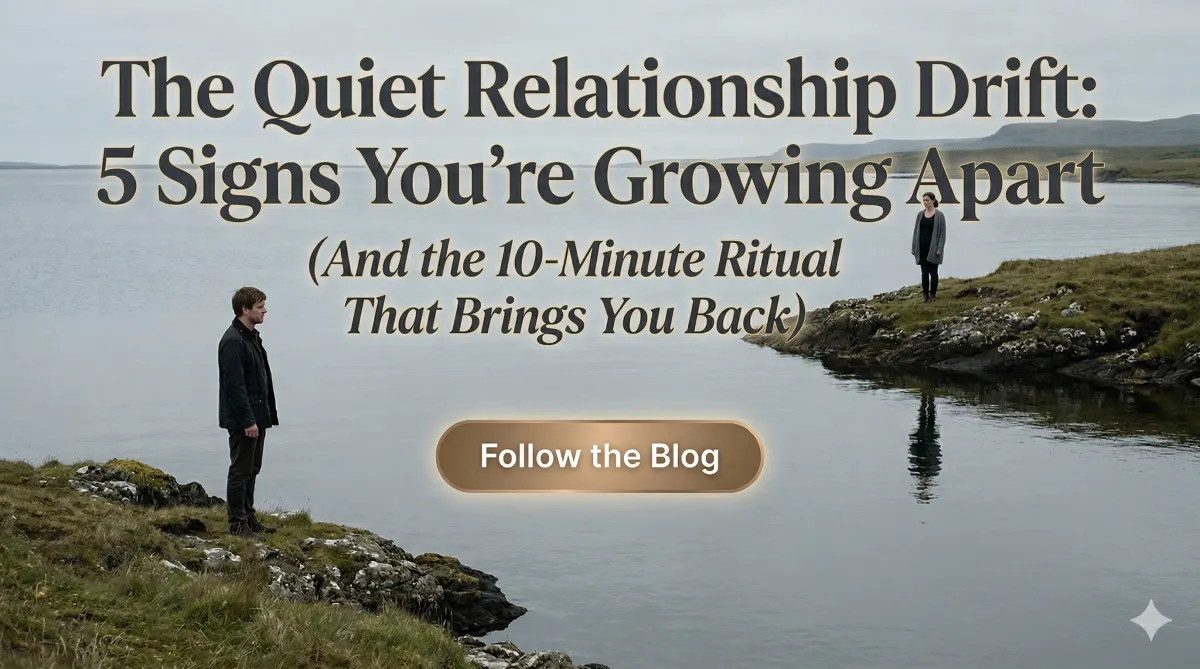
The Quiet Relationship Drift: 5 Signs You’re Growing Apart (And the 10-Minute Ritual That Brings You Back)

It doesn't announce itself. There's no argument, no ultimatum, no dramatic turning point. Emotional disconnection is the quietest thing that can happen between two people who still love each other.
Please note: The names Ryan and Sara are fictitious. The story, however, is real — drawn from the experiences of clients I've had the privilege of working with. Details have been changed to protect their privacy.
The first thing I noticed when Ryan and Sara joined our video call was that they weren't in the same room.
That detail stopped me quietly. They were in the same house — I could tell from the similar background light, the faint sound of the same street outside. But Ryan was at the kitchen table, laptop open in front of him, and Sara was somewhere else — a bedroom, maybe, or a study. Two separate frames on my screen. Two separate silences.
They hadn't planned it that way, Sara said quickly when I mentioned it. It had just sort of... happened. Ryan had already set up when she realized the call was starting. It was easier to join from where she was.
Easier. I held that word gently for a moment and didn't comment on it yet.
They had been together for nine years. They were — by their own description — "perfectly fine."
"We're not here because things are terrible," Sara said carefully. "We're here because things are... hollow. And I don't know when that happened."
Ryan looked just off-camera — that particular avoidance that screens make easier than rooms do. "She's right. I love her. I'm not in doubt about that. But I realized last month that I couldn't tell you the last time I genuinely felt close to her. Like — actually close. Not just in the same house."
Two separate screens. Same house. And somehow, miles apart.
I've sat with versions of this conversation more times than I can count. And what strikes me every time is the guilt that accompanies it — the sense that something has gone wrong that should have been caught sooner, that they should have noticed, that love should somehow have been enough to prevent this.
But emotional disconnection doesn't happen because people stop caring. It happens because life gets loud, and closeness requires a particular quality of quiet attention that's very easy to let slide.
"The couples who worry me least are the ones who argue. The ones who worry me most are the ones who've stopped expecting anything — who've made peace with a version of their relationship that no longer quite holds them."
Ryan and Sara weren't in crisis. They were in drift. And drift, left unchecked, has a destination.
Here are the five silent signs I observed in their relationship — and that I've seen surface, in different forms, in the stories of dozens of couples like them.
You've Replaced Conversation with Coordination
A Wednesday evening: Ryan gets home at 6:30. Sara is already in the kitchen. For the next forty minutes they talk — about the boiler quote that came in too high, about whose turn it is to call the letting agent, about whether they need another bag of dog food before the weekend. They eat together. The conversation never stops. By 8pm, they've said a hundred things to each other and learned nothing new about who the other person is that day.
This is one of the most deceptive signs of emotional disconnection — because it looks, from the outside, like communication. The talking never stops. There's always something to update each other on, something to decide, something to arrange. Life together generates endless logistical content.
But there's a difference between coordinating a shared life and actually inhabiting it together. One is operational. The other is intimate. And when all of a couple's conversational energy goes into the former, the latter quietly starves.
When I asked Ryan and Sara what they'd talked about at dinner in the past week, they both listed practical things without hesitation. When I asked what they'd learned about each other — what the other person was genuinely feeling, thinking, dreaming about, struggling with — there was a long pause.
"I don't know," Sara said quietly. "We were busy."
What I see as a coach:
Logistics are not the enemy of intimacy — they're just not a substitute for it. The sign to watch for isn't silence. It's when you realize that you could swap your partner for a competent housemate and the content of your conversations wouldn't change very much. That realization, when it comes, is worth paying serious attention to.
2. Touch Has Become Functional
A Sunday morning: Ryan puts his hand on Sara's shoulder as he passes her in the kitchen, reaching for the coffee. She doesn't register it — not because it was unwelcome, but because it barely landed. It was navigational. Like excusing yourself past someone on a train. Later that day, Sara thinks about the last time they touched and it meant something — when it was chosen, not incidental. She can't immediately place it.
Physical affection in long-term relationships follows a quiet arc that most couples don't notice until they look back at it. In the early years, touch is intentional — it communicates desire, curiosity, warmth. Over time, it becomes habitual: the kiss on the forehead before leaving, the automatic reach for a hand during a film, the shoulder pat in passing. Habitual touch isn't meaningless. But when touch stops being chosen and becomes purely functional — a reflex, a movement through shared space — something in the emotional register has gone quiet.
Sara told me, during our second session, that she and Ryan hadn't hugged — a real hug, not a greeting — in longer than she could pinpoint. "We kiss when one of us leaves. We sleep in the same bed. But I couldn't tell you the last time he held me like he actually wanted to be holding me."
What I see as a coach:
The body keeps score in both directions. Stress and emotional distance accumulate physically — we literally hold ourselves further apart, literally touch less purposefully. Restoring intentional, chosen physical contact — not as a prelude to anything, but as its own complete act — is one of the fastest ways to begin resetting the emotional temperature between two people.
"Emotional disconnection rarely feels like falling out of love. It feels like falling out of interest — in who your partner is becoming, and in who you are when you're with them."
You've Stopped Being Curious About Each Other
Sara mentions, almost in passing, that she's been thinking about retraining: She's been sitting with it for weeks, actually — turning over the idea quietly, doing research on her lunch breaks, lying awake with it. Ryan responds warmly: "Oh really? That's interesting." And then the conversation moves on. He doesn't ask what prompted it, what it would mean, what she's afraid of, what's making her want more. Three weeks later, he's forgotten she mentioned it at all.
Early in a relationship, we are insatiably curious about our partner. We want to know everything — their childhood, their opinions on things that don't matter, their strangest fear, their most embarrassing memory. That curiosity is part of what falling in love feels like: the appetite to know and be known.
In long-term relationships, that curiosity can quietly calcify into assumption. We think we know our partner, and so we stop asking. We file them — their preferences, their character, their likely reactions — and we stop updating the file. The person in front of us becomes, in a subtle but significant way, the person we decided they were three years ago.
The problem is that people keep becoming. Sara at thirty-six was not the Sara Ryan had fallen in love with at twenty-seven. Her fears had changed. Her ambitions had shifted. Her sense of herself had been quietly renegotiated by years of experience Ryan hadn't quite kept pace with — not out of indifference, but out of the comfortable assumption that he already knew her.
What I see as a coach:
One of the most quietly radical things you can do in a long-term relationship is to treat your partner as someone you are still in the process of meeting. Because you are. People are not finished. The version of your partner sitting across from you today has been somewhere you haven't fully followed. Ask about it.
4.Conflict Has Been Replaced by Avoidance
Ryan is frustrated about something that happened with Sara's family: It's not the first time this particular dynamic has bothered him. He's mentioned it before — once, obliquely, two years ago — and it landed badly and they moved past it. This time he feels the irritation rise and he makes a decision so fast he barely notices it: he swallows it. He puts the television on. Sara, on the other side of the room, has a vague awareness that something is off with him tonight. She doesn't ask. She's learned that pressing leads to deflection, and deflection leads to an atmosphere, and an atmosphere leads to a quiet, tense evening she doesn't have the energy for. So she doesn't ask.
When I tell couples that the absence of conflict can sometimes be a warning sign, I am usually met with genuine surprise. Aren't arguments bad? Isn't getting along what we're aiming for?
Not quite. Conflict, in a healthy relationship, is the mechanism by which two different people with different needs and different histories negotiate a shared life. It's functional. It's necessary. And when it disappears — not because everything is genuinely fine, but because both people have decided that the cost of raising something outweighs the benefit of resolving it — what replaces it is not peace. It's a carefully maintained performance of peace.
Ryan and Sara had become experts at this. They weren't angry with each other. They were something more corrosive: indifferent to the possibility of being understood. Each of them had, at some point, quietly concluded that certain things weren't worth raising. And those things had accumulated, unspoken, until the relationship was being conducted at arm's length.
What I see as a coach:
I always ask couples: what's the last thing you didn't say? Not the last argument — the last thing you consciously chose not to bring up. The answer to that question is almost always where the real work begins. Avoidance isn't neutral. Every time we choose not to raise something that matters, we're not keeping the peace — we're mortgaging it.
5. You Feel Lonelier Together Than Apart
Sara spends a weekend away visiting a close friend: She talks for three hours straight at the kitchen table — about things she hasn't articulated in months, about the retraining idea, about a fear she's been carrying quietly, about something funny that happened at work that she'd somehow never quite gotten around to telling Ryan. On the train home she feels the shift — the warmth of having been fully heard contracting as she approaches the life where, somehow, that kind of conversation doesn't seem to happen any more.
This is the sign that clients find hardest to say aloud, because it carries an edge of shame. How can you feel lonely when you are not alone? How can you feel unseen when your partner is right there?
But loneliness in relationships isn't about physical proximity. It's about the gap between who you actually are and who you feel permitted or able to be in the presence of the person you love. When that gap grows wide enough — when the version of you that comes out with friends, or alone, or in a journal, is significantly more alive than the version that shows up at home — that is disconnection. That is the relationship telling you something urgent.
Sara didn't realize, until she came back from that weekend, how much she had dimmed herself down. She had made herself manageable — quieter, less wanting, easier to be around. And Ryan, who loved her, had no idea, because he'd never seen the full-wattage version of her up close in years.
What I see as a coach:
When a client tells me they feel lonely in their relationship, I don't hear "I have the wrong partner." I hear "the conditions for connection have been allowed to erode." Those conditions can be rebuilt. But it requires both people to be honest about the gap — and willing to close it, even when that feels exposing.
The 10-Minute Weekly Check-In: Your Relationship's Reset Button
After our third session, I gave Ryan and Sara one instruction. Not a communication framework, not a book to read, not a list of exercises. One thing.
"Protect ten minutes on a Sunday evening," I said. "Pour something. Sit facing each other — in the same room this time. Do this."
Sara gave a small, knowing laugh. Ryan looked relieved that it wasn't more complicated. Both reactions are very common.
The 10-Minute Weekly Check-In isn't a therapy session in miniature. It's a container — a small, consistent, protected space in which two people can be honest with each other before the weight of what isn't being said becomes structural. It works not because it's clever, but because it's regular. Connection isn't built in grand moments. It's maintained in small, consistent ones.
Here's how it works.
The 10-Minute Weekly Check-In — A Structured Reset
Q1. What has felt hard for you this week that I might not know about?
Not a general check-in. This question specifically reaches for what's been carried quietly — the worry that wasn't mentioned, the frustration that was swallowed, the moment that stung and got filed away. Each person answers. The other listens without responding, without advising, without defending. Two minutes each. The rule: no fixing, only witnessing.
Q2. Is there anything between us right now that you're sitting with but haven't raised?
This is the question that does the real structural work. It names the avoidance pattern directly — not as an accusation, but as an open door. It gives both people permission to surface something small before it becomes something calcified. If the answer is genuinely no, wonderful. If there's a hesitation before the no — that hesitation is where you go next.
Q3. What's something you're excited about, curious about, or quietly hoping for right now?
This question rebuilds curiosity. It invites the part of your partner's inner world that doesn't get discussed in logistical conversation — the retraining idea, the creative project, the thing they've been reading about, the trip they're fantasizing about. It says: I'm still interested in who you're becoming. And that, over time, is one of the most powerful things you can communicate to someone you love.
Q4. How connected have you felt to me this week — and what would more of that look like?
This is the question most couples initially find the most exposing — and the one that creates the most movement. It makes connection itself the topic, rather than leaving it to be implied by everything else. The second part matters as much as the first: not just "did you feel close to me?" but "what would closeness actually look like, specifically, right now?" Vague answers are allowed. Even "I don't know, but not this" is more than most couples manage to say out loud.
Q5. What's one thing I can do for you in the coming week — and one thing you're offering me?
The check-in closes with reciprocity. Not a negotiation, not a demand list — a single, specific, freely offered gesture on each side. It might be practical ("don't talk to me before I've had coffee"), it might be emotional ("check in when you know I'm anxious about Thursday"), it might be playful ("suggest something to do together that isn't watching television"). Small and real beats grand and vague every time. Finish with the question, then put down your phones and sit together for just a moment — in the quiet of having actually been honest with each other.
Ryan and Sara tried it for the first time on a Sunday evening in October. Poured wine. Sat at the kitchen table — in the same room, facing each other, which already felt like something. Sara answered the first question and started crying somewhere in the middle, not dramatically, just the way tears come when something has been held for a while. Ryan didn't try to fix it. He just said: "I didn't know you were carrying that."
"I know," she said. "I didn't tell you."
That exchange — six words each — was more emotionally honest than anything they'd said to each other in months.
The check-in took fourteen minutes. Ryan messaged me that evening: just three words. That was something.
I want to say something carefully here, because I think it matters.
If you recognized yourself in any of the five signs above — if some part of you felt the small, specific ache of being seen in these pages — please don't read that as a verdict. Emotional disconnection in a long-term relationship is not a failure of love. It is not evidence that you chose the wrong person, or that the relationship is past saving, or that something has gone permanently dark.
It is evidence that you are human. That life got in the way. That intimacy requires tending and the tending got deprioritized somewhere between the mortgage and the career and the dog and the ten thousand other things that fill a shared life to the edges.
Ryan and Sara still check in with me, occasionally. Less often now. Last month, Sara told me that she and Ryan have done the weekly check-in almost every Sunday for seven months. She said some weeks it's transformative. Some weeks it's ten minutes of mild boredom and nothing much to report. "But even those weeks," she said, "I know he showed up for it. And that means something."
Reconnection isn't a moment. It's a practice. And it begins — as most important things do — with simply turning toward each other and being willing to be honest.
Ten minutes. Once a week. That's the whole ask.
Recognize yourself in this?
Emotional disconnection is one of the most common — and most treatable — patterns I work with. If you and your partner are in the drift described here, online coaching can help you find your way back to each other before the distance becomes structural. Reach out to start that conversation.
#EmotionalDisconnection#RelationshipAdvice#LongTermRelationships#CouplesCoaching#IntimacyInRelationships#EmotionalIntimacy#RelationshipHealth#WeeklyCheckIn

Handcrafted by Coach Foundation | Copyright © 2023 Swati Mukherjee's Coaching. All Rights Reserved.